
Reflections on the 4th Annual Challenging Racism Conference, University of Westminster
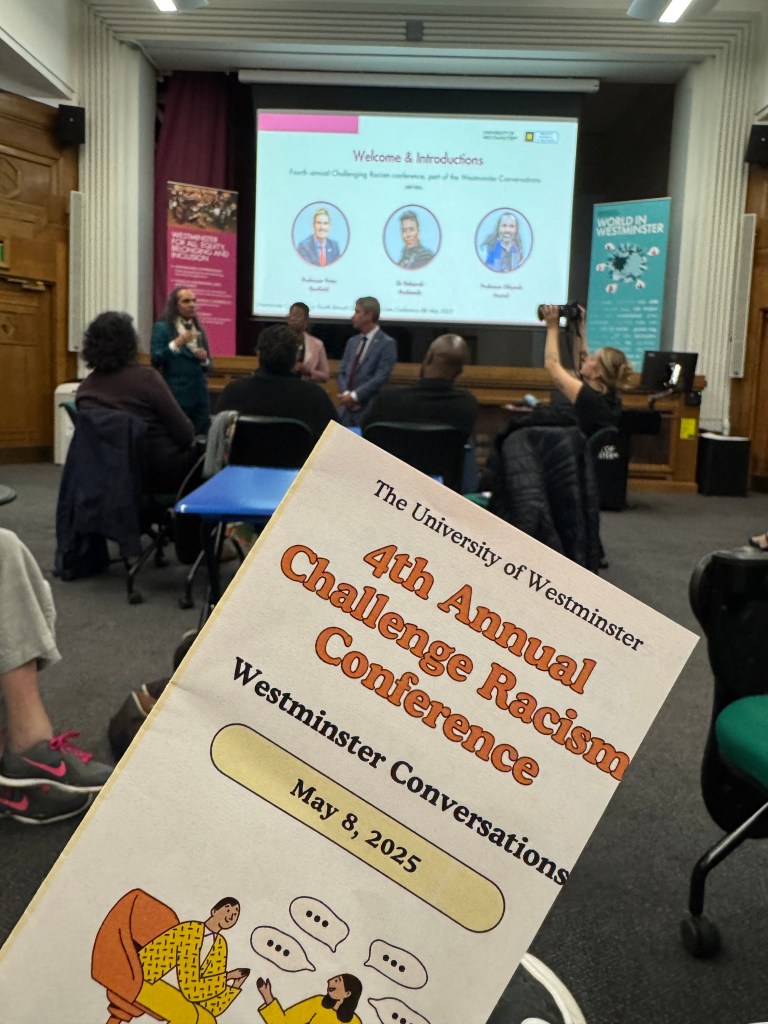
On 8th May 2025, we had the honour of attending the 4th Annual Challenging Racism Conference hosted by the University of Westminster. This annual gathering continues to grow as a vital forum, not only for academics and students, but also for the wider public committed to dismantling racism in all its forms, across disciplines, institutions and borders.
The energy in the room was one of deep engagement and care. Every panel was rich in perspective, each speaker bringing forward their research, their stories, and their truth with remarkable clarity and courage. The conference created a space where critical dialogue was not only encouraged but grounded in solidarity and mutual respect. It is this spirit…this shared willingness to listen, to learn, and to act…that stood out most for me. So often anti-racist work in academic spaces is weighed down by bureaucracy or diluted in abstraction. But here, the message was lived, felt, and beautifully articulated. Our gratitude goes out to the organisers, the moderators and, above all, the panellists who carried the day with such integrity.
One of the most powerful contributions came from Palestinian-Italian Associate Professor Zahira Jaser, who spoke with quiet strength and emotion about identity, displacement and the love that endures even in the midst of profound injustice. Her words were not just informative but transformative. She spoke not as a representative or a symbol, but as a human being navigating the violence of categorisation and erasure. Her framing of love, not as a passive state but as an active political ethic, resonated deeply. It demonstrated that love in itself is a form of resistance. It is the refusal to dehumanise, even while being dehumanised. It is, in itself, a challenge to racism’s core logic. That message captured the deeper truth of the conference: that anti-racism is not only about critique, but about care. It is about the conditions in which dignity can be restored and protected.
And it is exactly for this reason that moments of attempted disruption, which we will not dignify with detail here, must be seen for what they are: irrelevant to the momentum of love, solidarity and truth that filled the room. Yes, there was an effort to distract and derail. Yes, the attempt was calculated, perhaps even expected. But it failed. Why? Because the room knew better. The audience recognised what was happening, and rather than shifting their gaze to the performance, they held fast to the message being delivered. The panel stood firm and in solidarity. The collective attention refused to be stolen. That refusal…quiet, firm, and united…was its own form of resistance.
It would be a mistake to dedicate space to that kind of attention-seeking behaviour. And we won’t. Not because it wasn’t noticeable, but because it should not be important. What mattered that day was not the attempt to dominate, but the shared commitment to understanding and justice that endured despite it. We were also deeply proud of how our university responded: with professionalism, composure and an unwavering commitment to the values the conference was built upon. The institution did not indulge the spectacle. It remained focused on centring dignity, equity and care. That too is resistance, and that is the story we want to tell.
The real lesson of that moment is not about interruption, but about what persisted in its wake: a powerful reminder that spaces of anti-racist learning must do more than merely “tolerate difference” (we have serious reservations of using this kind of discourse). They must protect those who speak from the margins and amplify those whose truths are too often dismissed, distorted or discredited. In a world where Palestinian voices are routinely silenced or forced to account for the actions of others, it is not enough to simply offer them a seat at the table. We must also defend their right to speak without interrogation, without suspicion and without being reduced to a stereotype. This is not about special treatment. It is about equity, safety and basic human respect. That is what this conference made clear.
As Dr Deborah Husbands rightly noted during the conference, in light of the current landscape in the United States, we are privileged to still have the opportunity to host events like this in the UK. Her reminder struck a chord. While we continue to face challenges here, we must not lose sight of the alarming developments elsewhere, where academic spaces are being aggressively policed, and the very notion of critical race dialogue is under siege. In the US, Donald Trump is actively dismantling so-called DEI (Diversity, Equity and Inclusion) initiatives, targeting students who protest in solidarity with Palestinians and deporting international students who dare to speak out against state violence. The clampdown on peaceful protest, particularly around Palestinian solidarity, is an attack on academic freedom itself. It stands in direct contradiction to the “freedom of speech” that Trump and his associates so often claim to champion. Let’s be clear: freedom of speech is not real if it only protects power. It is not free when it punishes dissent. That is why spaces like ours matter, and why we must defend them now more than ever.
It affirmed that lived experience is not secondary to theory, but is foundational to understanding how racism operates and how it can be undone. It reminded us that academic freedom must never be used as a shield for harassment or spectacle. And it made visible…perhaps painfully…the very dynamics we are trying to challenge: the relentless pressure placed on marginalised people to explain themselves, to remain composed and to keep teaching even in the face of harm or violence.
But the harm did not define the day. Love, in the form of generous listening, mutual care and honest engagement, was the defining atmosphere of the conference. It was present in the thoughtful questions asked, in the solidarity between panellists, in the fierce quiet that followed a moment of attempted provocation, and in how panellists and organisers were approached in private to check on their mental and physical wellbeing. It was in the way people stayed behind to connect, to network, to share and to carry the work forward. And that is where I want to leave this reflection…not with the noise, but with the message.
To all the speakers: thank you. Your knowledge is more than academic. It is vital, living and deeply needed. To the organisers: thank you for creating this space and for continuing to hold it open in a time when so many would prefer silence. To our fellow attendees: let us carry the conference with us not just in our notes, but in our choices, our conversations, and our refusal to allow disruption to define the narrative. Racism is not something that will be dismantled in one event or even in one generation. But in moments like these, where truth is spoken and love endures, we take steps forward…together.
Dr Dan Petrosian & Dr Sinem Bozkurt
 Criminology with Dan