
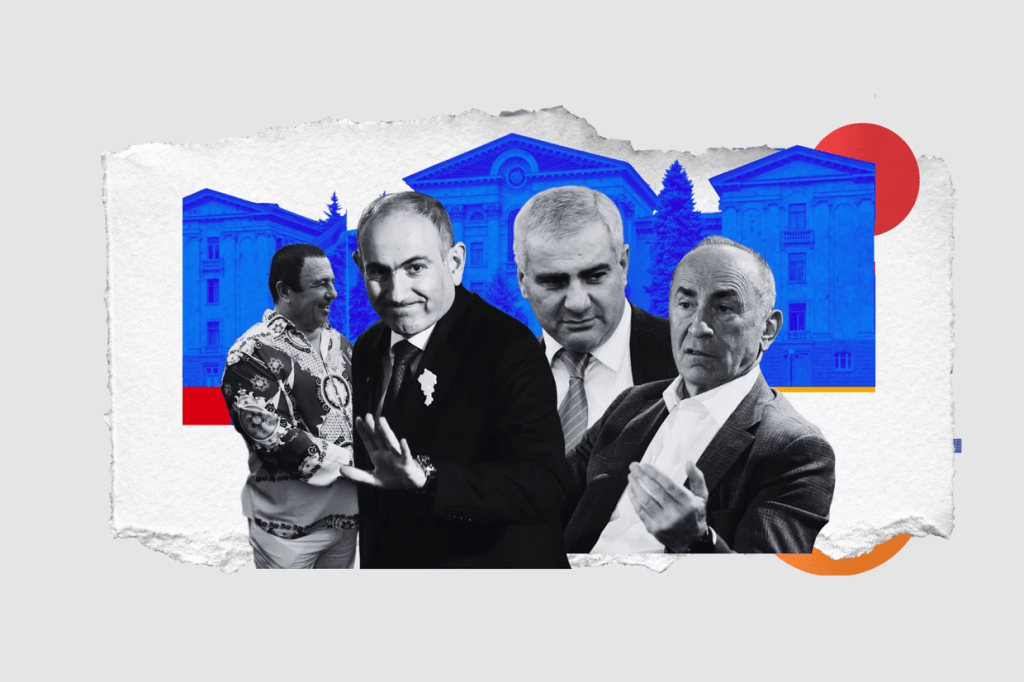
As the Armenian people vote in what may be the most consequential election since independence, I find myself feeling something that I suspect many Armenians feel today: anger, exhaustion and profound uncertainty about what comes next.
The Republic of Armenia that goes to the polls in 2026 is not the Armenia that emerged from the Velvet Revolution in 2018. It is a country traumatised by war, shattered by the loss of Artsakh, haunted by the displacement of more than 100,000 Armenians from Nagorno-Karabakh and increasingly caught between competing centres of power that all claim to know what is best for its future. The optimism that once surrounded the incumbent Prime Minister Nikol Pashinyan has long since evaporated. In its place sits a deep national frustration that has only intensified since the collapse of Armenian control over Nagorno-Karabakh in 2023 and the mass exodus of its Armenian population.
It would be dishonest to pretend that this anger is irrational. Much of it has been earned.
Pashinyan’s critics accuse him of presiding over the greatest national humiliation since independence. They point to the loss of Artsakh, his increasingly controversial statements regarding Karabakh and Armenian history, his willingness to pursue constitutional changes demanded by neighbouring Azerbaijan as part of a peace settlement and his efforts to normalise relations with both Azerbaijan and Turkey despite the painful history still clouding over these relations. Supporters describe this as realism, opponents describe it as capitulation. Either way, many Armenians feel that they are being asked not merely to accept military defeat, but essentially to accept a rewriting of their national story.
The result is a crisis of trust. A government that once promised dignity, sovereignty and democratic renewal is now viewed by many citizens as having delivered loss, retreat and humiliation instead. The political damage is visible everywhere, from the bitter dispute between Pashinyan and the Armenian Apostolic Church to the increasingly hostile rhetoric dominating public life. Even sympathetic observers acknowledge that the Prime Minister enters this election as a deeply divisive figure.
Yet despite all of this, I cannot bring myself to support a return to the old order.
This is where I part company with many of Pashinyan’s critics. The understandable rage directed at the current government should not blind anyone to the nature of the alternative. Robert Kocharyan, Serzh Sargsyan and the mafia-style political culture they represent are not the answer to Armenia’s problems. They are among the reasons those problems exist in the first place, a disease so deeply entrenched in the Republic’s culture, rotting its values and sense of common purpose and decency.
For decades, Armenia was governed by a post-Soviet elite that wrapped itself in patriotic language while overseeing corruption, oligarchic influence, economic stagnation and increasing dependence upon Moscow. The same people who now present themselves as defenders of Armenian national interests spent years helping to create a political system that left Armenia vulnerable, isolated and indebted to Russia. The idea that those same figures should now be trusted to somehow “rescue” the nation strikes me as absurd and verging on maniacal.
More importantly, a return to that political tradition would almost certainly pull Armenia back towards Russia at precisely the moment the country is trying to establish a genuinely independent foreign policy. This election is not simply about personalities, but about whether Armenia remains trapped in the geopolitical orbit of a declining imperial power or attempts, however imperfectly, to steer its own course. The overwhelming majority of the opposition’s most powerful figures continue to favour closer ties with Moscow, while the current PM has spent the last several years distancing Armenia from Russia, suspending participation in the CSTO and expanding engagement with the European Union and the United States.
What makes Russia’s position particularly infuriating is its extraordinary hypocrisy.
For years Armenians were told that Russia was their indispensable ally and security guarantor. Yet when Nagorno-Karabakh fell and Armenian families fled their homes carrying what little they could salvage from generations of history, Moscow stood by and watched. The Kremlin that endlessly lectures Armenia about loyalty proved incapable or unwilling to protect the very people whose dependence it had cultivated for decades. Since then, relations have deteriorated sharply, with accusations of Russian political interference, economic pressure and attempts to prevent Armenia’s westward drift becoming increasingly common.
This is why I find the current moment so tragic. Millions of Armenians are being forced to choose between a government that many no longer trust and an opposition that offers a vision rooted in the same failed dependencies that have held Armenia back for decades. It is a choice between disappointment and regression, between frustration and nostalgia, between an uncertain future and a deeply familiar past that was hardly glorious. Nor am I convinced that the West deserves the romanticised image that some people project onto it. European leaders may speak warmly about democracy and sovereignty…American politicians may praise Armenia’s “democratic development”… but recent history provides little reason to believe that either Brussels or Washington will come riding to Armenia’s rescue if a serious crisis emerges. Geopolitics is not charity. States act in their own selfish interests.
Nevertheless, if Armenia is to have any chance of building a genuinely sovereign future, it must be able to make decisions free from Kremlin intimidation. The country has already paid too high a price for dependence. Whatever I (and many) may think of Pashinyan, and there is much to criticise, the Republic’s future cannot lie in handing power back to the same political forces that spent decades deepening Moscow’s influence over every aspect of Armenian life.
The deepest tragedy of this election is that so many Armenians feel they are voting not for a hopeful future but against a feared one. Yet perhaps that is where Armenian politics finds itself after the catastrophe of Artsakh: wounded, angry, distrustful and searching for a path forward through circumstances that offer no easy answers.
Tonight’s result will not heal those wounds. It will of course also not restore Artsakh. It will not erase the mistakes of the past. It may, however, determine whether Armenia spends the next decade struggling towards genuine sovereignty or just sliding back into the embrace of the very power that has repeatedly failed it when it mattered most.

